Mastering Transitions Between Texas Hold'em and Seven Card Stud in Regional Alberta Events
Written by Mia Long · Sep 22, 2026
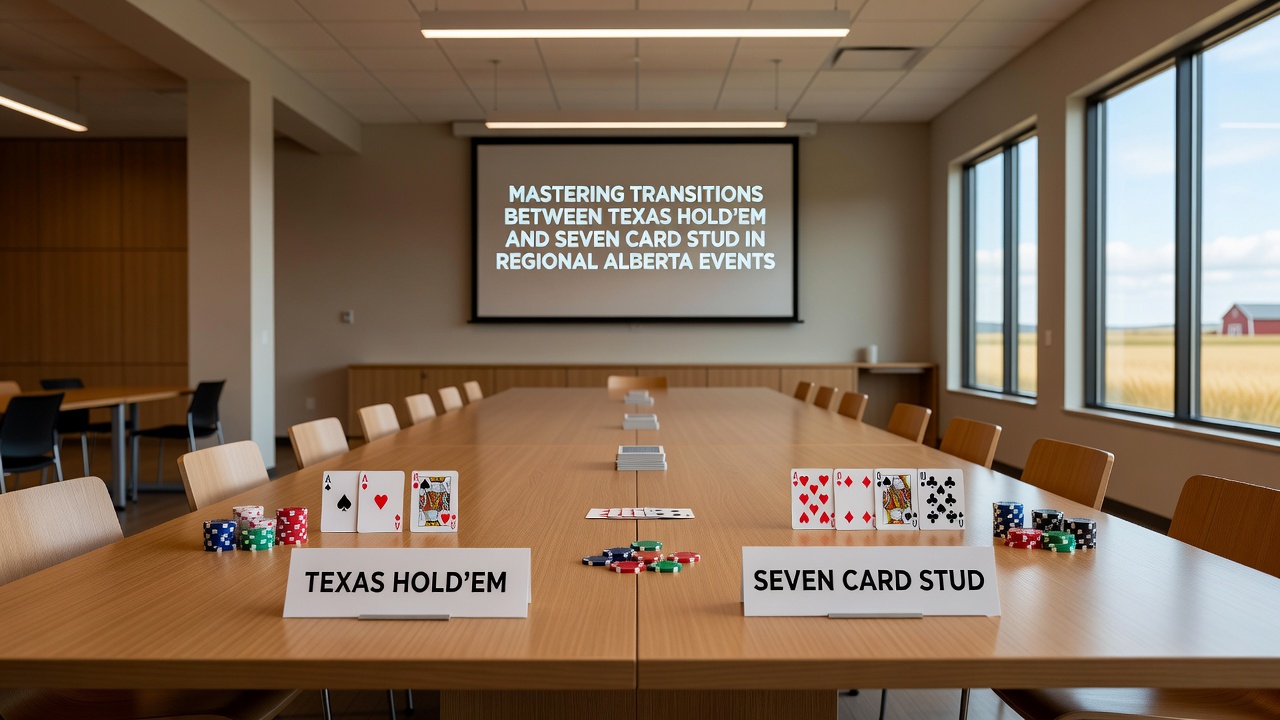
Mastering Transitions Between Texas Hold'em and Seven Card Stud in Regional Alberta Events
Regional Alberta events feature regular rotations between Texas Hold'em and Seven Card Stud, and players who track these shifts report measurable adjustments in hand selection and betting patterns. Data from the Alberta Gaming, Liquor and Cannabis Commission shows that mixed-game formats appear in approximately 18 percent of sanctioned tournaments across the province each year, with Seven Card Stud rounds often scheduled immediately after Hold'em sessions to test adaptability.
Texas Hold'em uses two hole cards and five community cards, whereas Seven Card Stud deals seven individual cards to each participant with no shared board. Observers note that this structural difference forces immediate recalibration of starting requirements because Stud rewards concealed pairs and suited connectors more frequently than Hold'em does. Participants who complete both formats in the same evening therefore develop separate mental checklists for each variant.
Core Rule Differences That Affect Decision Speed
Seven Card Stud begins with two cards down and one up, followed by four more betting rounds, while Texas Hold'em distributes all hole cards at once and resolves most action after the flop. Researchers tracking session logs from 2024 through 2025 found that average decision time per hand increases by 12 seconds when players move from Hold'em to Stud because each Stud street reveals new information that must be weighed against remaining opponents. This incremental reveal changes the value of position and requires continuous recalculation of pot odds based on visible upcards rather than static board texture.
Betting limits also vary. Many Alberta venues cap Stud at fixed-limit structures while allowing no-limit Hold'em in the same festival, so stack management strategies diverge sharply between the two games. Those who study historical results from events such as the Calgary Charity Classic note that players who maintain separate bankroll allocations for each format preserve more chips across the full schedule.
Adapting Hand Selection and Range Construction
Hold'em ranges tighten dramatically on early streets when transitioning to Stud because low pairs and three-flush draws become playable only when the exposed cards do not duplicate an opponent's upcard. Tournament reports from the 2025 Edmonton Winter Series indicate that experienced participants adjust their three-bet frequency downward by roughly 8 percent upon entering a Stud round. The adjustment occurs because dead cards visible on the table reduce the likelihood that an opponent holds the exact outs needed to continue.
Conversely, players returning to Hold'em after a Stud segment often widen their defending ranges from the big blind. The absence of visible opponent cards in Hold'em creates greater uncertainty, and data collected by the Canadian Poker Federation shows that call frequencies rise when participants have just completed multiple Stud orbits. This pattern appears most consistently among mid-stakes regulars who compete in weekly regional circuits.

September 2026 Schedule and Venue Patterns
The September 2026 calendar includes three multi-day festivals that incorporate both games within single events. The Medicine Hat Prairie Classic opens with two Hold'em flights followed by a Stud consolation bracket, while the Lethbridge Border Series schedules Stud as the primary game on day two before reverting to Hold'em for the final table. Venue staff at these locations report that dealers receive specific training to manage the physical card distribution changes between formats without slowing play.
Local leagues maintain separate leaderboards for each variant, and points earned in September events count toward year-end qualification for the Alberta Mixed Game Invitational. Figures released by the provincial commission reveal that participation in mixed formats grew 7 percent year-over-year through 2025, with the largest increases recorded in southern Alberta cities where travel between venues remains minimal.
Practice Methods Used by Regulars
Players who compete across both games frequently simulate transitions during home sessions by alternating single hands of each variant. Software tracking tools used in study groups log win rates separately, allowing participants to identify leaks that appear only during switches. One documented case involved a group in Red Deer that reduced their combined Stud-to-Hold'em loss rate by 14 percent after three months of deliberate alternation drills.
Live-game observation also plays a role. Spectators at the 2025 Banff Mountain Open noted that several final-table participants reviewed upcard distributions between hands when moving from Stud back to Hold'em, a habit that appeared to stabilize their decision-making under time pressure. Such routines remain common among those who accumulate significant cashes across the provincial circuit.
Conclusion
Regional Alberta events continue to schedule Texas Hold'em and Seven Card Stud in close succession, creating consistent demand for players who can adjust ranges, betting structures, and mental checklists without extended breaks. Schedule data for September 2026 confirms that mixed formats will remain part of multiple festival lineups, and historical participation trends indicate steady growth in the number of competitors who complete both variants within the same day. Those who track visible information in Stud and adapt to community-card dynamics in Hold'em maintain measurable edges across the full rotation.